The Paran - General Description
Parans (from the Greek stellon or co-transits) occur when two celestial bodies, usually planets or fixed stars, cross the angles at the same time. The angles referred to here are the Horizon and Meridian, but often practitioners use the East and West points as well. Actually, all that is needed is for two or more planets to have the potential to cross the angles simultaneously at the geographic latitude for which the chart is drawn. Parans are a vestige of Babylonian Astrology which focused on the Horizon. In that era, the Ecliptic was unknown and astrology was centered on the Horizon.
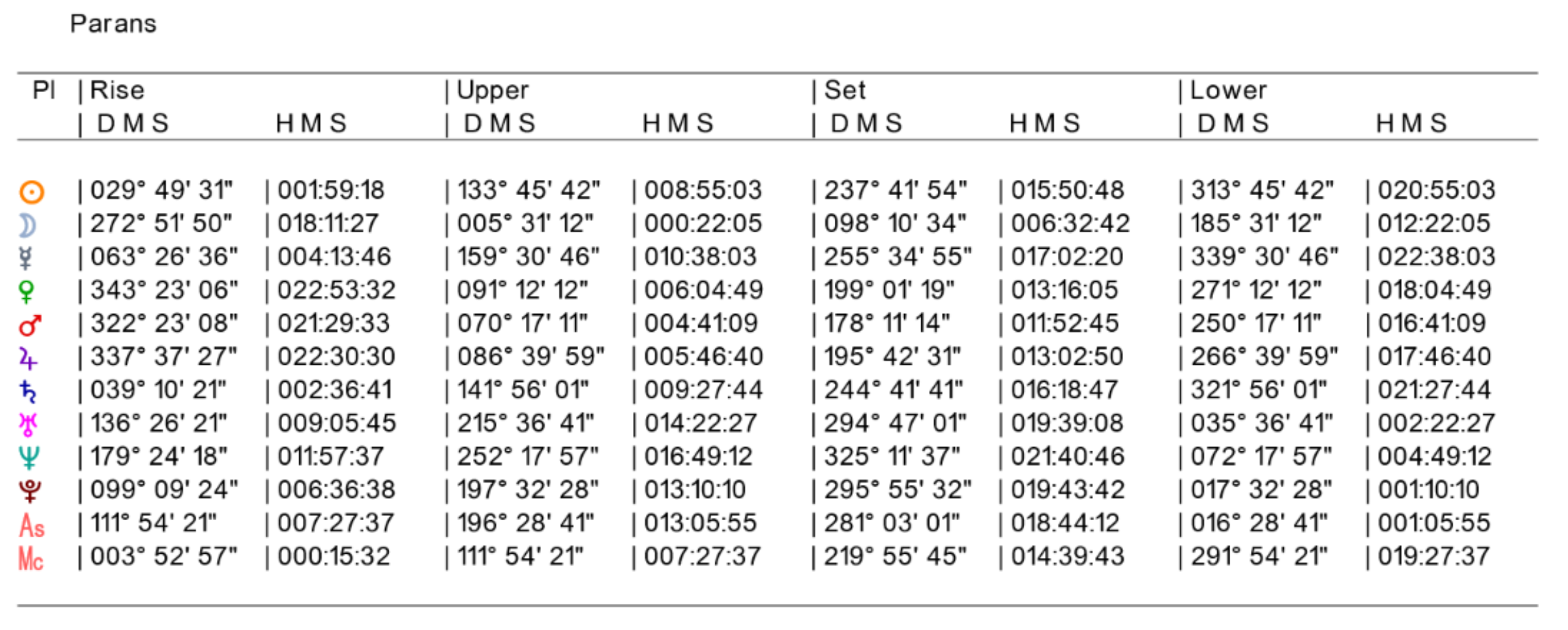
This is the first of three paran tables in the Speculum for a single chart. The In Mundo positions are represented by both degrees, minutes and seconds but also by time as hours, minutes and seconds. This table is in planetary order and lists the Sidereal Time of the planets rise, Upper Meridian crossing, the planets set and Lower Meridian crossing.
The following are examples of parans:
Planet A rises on the East Horizon (Ascendent) with planet B. Planet A rises while planet B sets on the West Horizon. Planet A rises while planet B culminates on the Upper Meridian. Planet A rises while planet B anti-culminates at the Lower Meridian. Planet A sets while planet B rises, culminates, anti-culminates or sets. Other great circle simultaneous crossings can also be considered sensitive as well such as East Point or West Point with a culmination, etc.
It may be helpful to reiterate that the familiar MC (Midheaven) is the point where the ecliptic crosses the Upper Meridian, the IC is the point where the ecliptic crosses the Lower Meridian, the Ascendant is the point where the Ecliptic rises across the Horizon, almost always the East Horizon (occasionally in the west in the Arctic and Antarctic latitudes). The Descendant is the Ecliptic's setting point on the Horizon in the west. Again, polar latitudes can complicate the problem, although in practice this is rarely encountered.
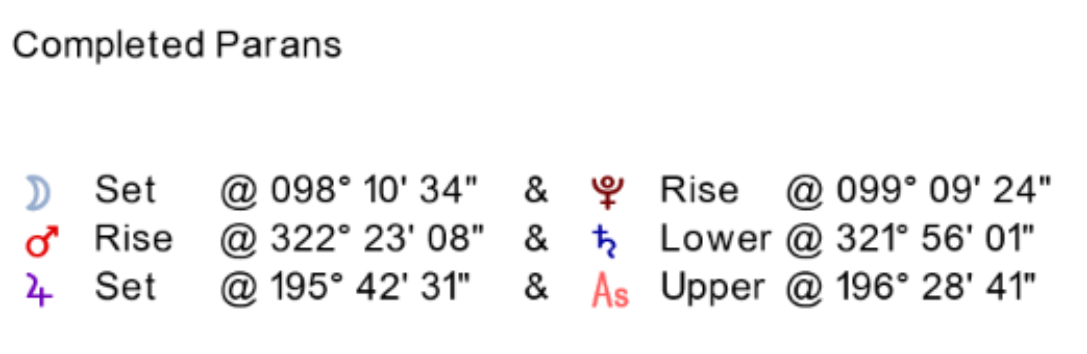
The next table is a listing of the Completed Parans. This sums up the raw material in the paran tables to show completed parans within a 1° orb. Thus, when Tom Brady’s w sets on the Western Horizon, his p Rises on the Eastern Horizon. When his t rises, his u crosses the Lower Meridian. These are unique conditions based on his natal chart and his location and occur every day as the Earth turns on its axis.
In the Parans printout the planetary positions are given in degrees from 0 to 360 and in hours, minutes and seconds of sidereal time, both ways may be handy, depending on the situation where you use them. You can read the planetary pair as you would read a planetary pair in the more familiar Ecliptic aspect, being attentive to the relative closeness of the two planets as a key to their interpretive strength. If two planets are in paran and only a few minutes apart in their angle-crossings then the contact should be stronger than if they cross through the angular foreground 5 degrees (- 20 minutes of sidereal time) from each other. While the orb to use for these contacts is a personal preference from one’s observation, an orb of 1° for degrees and 4 minutes for sidereal time is common.
Another means for judging strength is whether the two (or more) paran planets are located near the angles (making them strong to begin with) or whether the planets are in the background of the chart and only hold the potential for crossing angles together (making a weaker starting condition). In the Central German style schools of thought, like Symmetrical or Uranian Astrology, the Personal Points are essential for judging the hierarchy and importance of the combinations. Parans which are natally in the angular foreground are said to be in a mundane square with each other.
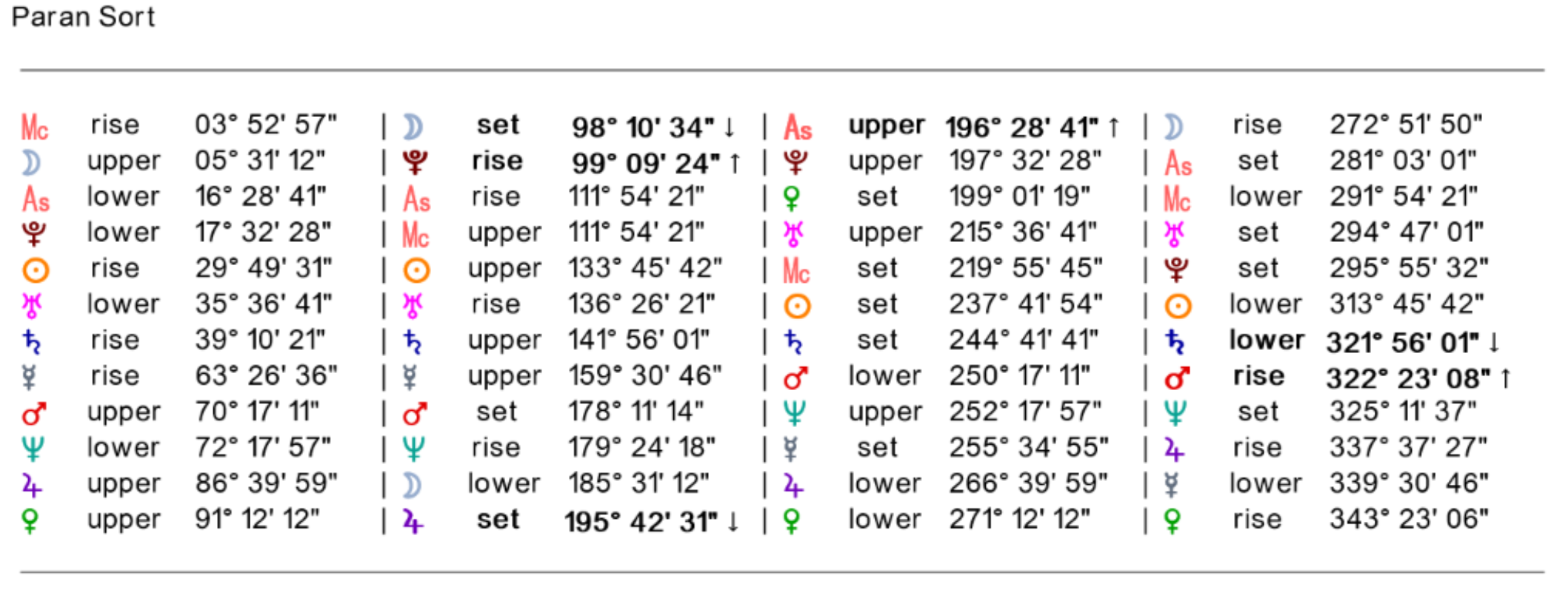
The final table in a natal Speculum is a degree sort of the Paran table, which lists the material in planetary order. This handy sort allows you to see the order that the planets are hitting the angles and the time between hits. Planets and factors within a 1° orb in the listing are bolded with an arrow showing the connection.
Solar Fire X by Astrolabe Inc Copyright © All rights reserved.