The Coord Button
The Coord (Coordinate button) opens a drop-down list of various coordinate systems and declination layouts for you to select. Each of the various selections transforms the horoscope for a new coordinate system. You can manipulate charts and material displayed on the Dials and when you hit the Home key, you will clean the chart and return to its origins but you remain in the chosen Coordinate until you choose another Coordinate System to display. If you right click (Mac: Ctrl + click) the Home button, the displayed chart is added to the Retained Charts list in the Main Solar Fire menu.
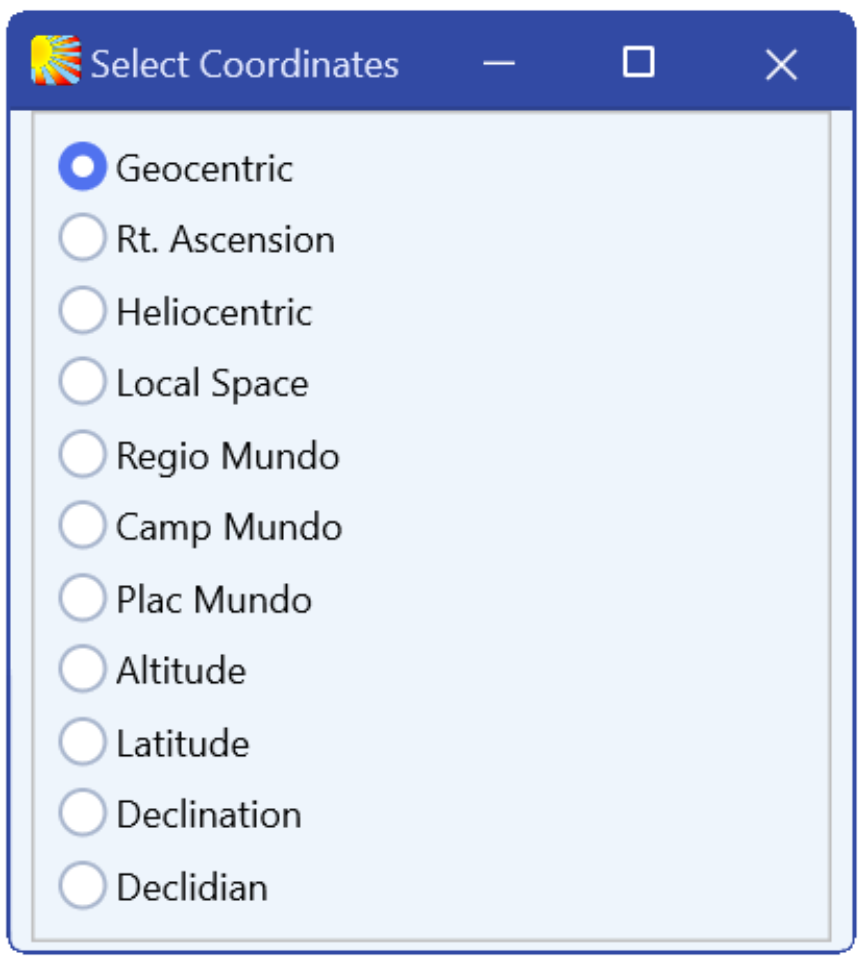
The Coord button lists various coordinate styles and layouts. Selecting any of them will instantly convert the material on the Dial into the selected Coordinate system. The Dial will retain all its standard motions and abilities in each of these systems.
When you choose Geocentric, you choose the zodiacal based great circle, the Ecliptic, to project the horoscope which is used by most astrologers to create a horoscope. Everything we do in astrology is usually defaulted to the Geocentric framework.
When you choose to project the chart using Right Ascension (Rt. Ascension), you are projecting the planets and factors onto the Equator, the fundamental plane of the Earth. Most of the planets are on the zodiacal plane, discussed above, except the Midheaven. The Meridian vertical great circle intersects the Equator at a right angle, making it a fundamental part of the measuring system utilizing the Equator. This intersection point is called the RAMC (Right Ascension of the Medium Coeli), or sometimes, the Sigma Point. Measuring time is done using the Equator where space and time have an equivalency using the Equator where each degree of RA (Right Ascension) equals 4 minutes of time. We measure Declination north or south using the Equator as the starting plane and where the Ecliptic crosses the Equator is called the Cardinal Axis and, in the east, (this crossing is called the Aries Point) is the starting point for counting positions on the Ecliptic and Equator. Such a crossing is called a Node and we distinguish such crossings by naming them, such as where the Moon’s orbit crosses the Ecliptic plane is called the Moon’s Node. Right Ascension charts are used in mundane and financial astrology. They are also fundamental to such dynamic systems as Primary Directions.
Choosing Heliocentric creates a Solar Plane based chart where the Earth is always opposite the Sun (which is not shown in a Heliocentric chart, nor is the Moon). And the Earth is represented by an Earth symbol (Û). There are no retrogrades in the Heliocentric System and Mercury is the fastest object. Since this is based on the Sun, there is no Ascendant, Midheaven or Moon.
The last of the major coordinate systems used in general astrology is the Local Space system where the planets and factors are laid out on the Horizon great circle. There are two forms in Local Space and it has to do with starting points. In astrology and Solar Fire, we use the Local Space orientation promoted by Micheal Erlewine, which starts counting degrees along the Horizon, counterclockwise, from the East Point (where the Equator, Horizon and Prime Vertical cross in the East). Modern navigation starts with the North Point (it used to start with the South Point) and the Azimuth (East-West measurement on the Horizon plane) is measured clockwise.
Local Space, as used in astrology, shows planetary positions indicating which places or directions we may head toward are controlled by various planets. The projection of the Horizon along with the MC are the basics of the observation for locating Parans (from the Greek paranatellon, meaning co-transits or when planets and factors are mundanely connected by physically rising together or crossing angles simultaneously). The Horizon is also fundamental in understanding Primary Directions.
The Regiomontanus (Regio Mundo), Campanus (Camp Mundo) and Placidus (Plac Mundo) Mundoscope charts use a system of Zodiacal Analogues. The planets are given positions in what looks like (but really isn't) longitude. It may help to state that one should NOT compare these positions to real (tropical or sidereal) longitudes.
Astrologers have not agreed with each other as to the best way to compute mundane aspects, like mundane squares, for planets in the intermediate houses. These systems allow you to experiment to see which system (if any) gives the best results. Since the location of the intermediate cusps differ from system to system; a square in one system may not be a square in another.
A reason to investigate mundane position systems would be twins born just a few minutes apart. Close twins may have quite different in mundo aspects in their charts since these mundane contacts change so quickly, unlike aspects on the ecliptic. Despite similarities, twins are often quite different in temperament and destiny; it is unlikely that this can be shown by their ordinary ecliptic aspects.
The primary reference circle of the Regiomontanus Mundoscope is the Celestial Equator. The primary reference circle of the Campanus Mundoscope is the Prime Vertical. In both systems the houses are semi-circles of position (or Lunes) originating from the north and south points of the horizon. Planetary position is determined by a semi-circle of position passing through the planet’s position in the mundane sphere and projected on the Equator (Regiomontanus) or Prime Vertical (Campanus) by right angles.
The Placidus Mundoscope uses what might be very loosely termed the Diurnal Circle and this system is the one most like that used by Michel and Francoise Gauquelin in their work.
Mundoscopes (also called Analog charts) are also discussed in Uses of the Full Speculum and Casting an Harmonic, Transform, Antiscia or Analogue Chart with instructions how to generate them elsewhere in Solar Fire.
The choice of Altitude or Latitude uses the 360° Dial’s Aries-Libra Axis to display how far from the Horizon, North or South (Altitude) the planets and factors are. The Latitude uses the same measurement (Aries-Libra Axis) to show how far North or South the planets are in relation to their Ecliptic positions.
When you select Declination, the Aries-Libra Axis is used like the Equator and the positions of the planets and factors, North or South, is shown above or below the representation of the Equatorial Plane. When you look in the Position Marquee in the Information window, the Declination items are still listed in Zodiacal order, not degrees North or South.
The last item to choose is the Declidian. Here, the planets and factors are plotted onto the Meridian Great Circle for use in Declination studies.
Solar Fire X by Astrolabe Inc Copyright © All rights reserved.